
Breaking News
Obituary
9th October 2024
Cyril Plimmer
Cyril Plimmer, Chairman of the Boulton Paul Association, passed away peacefully on the evening of Wednesday the 9th of October 2024, his last few days having been spent in the capable hands of the staff at Compton Care.

Cyril was born on 5th March 1928 at 4 Armoury Terrace, Wenlock Road, Shrewsbury, the son of Stanley Claude and Gladys May Plimmer, moving to Newport and later to Wolverhampton in 1934. He took an interest in Boulton Paul Aircraft when his father obtained a job there as a fitter. On 6th March 1942 at 14 he started work as an office boy at the factory with the potential of an apprenticeship upon reaching 16 provided he worked hard to get a school certificate in the meantime. True to the promise his apprenticeship started on 5th March 1944 and was ratified by the Directors at their meeting of 24th August 1944. Unfortunately, shortly after starting the new task he had a major injury to his leg while playing football which required serious surgery, delaying work for almost a year and leaving him with the permanent limp of a shortened right leg. It was 1949 before he moved into the drawing office on aircraft design as a junior draughtsman. In 1953 showing such enthusiasm and promise he was asked to join the hydraulics design team working on an early fly-by-wire control system for the Tay Viscount. From then onwards he was at the forefront of advanced flight control design work.
As the requirements for more advanced systems and Concorde raised their head Cyril was part of the team formed to produce new proposals and tender for new orders. Work included designing the Hunter Mk.12 majority vote system actuators and its later experiments with the special Oronite M2V fluid to be employed on Concorde. Rationalization of the aircraft industry led to gaps in enquiries during 1958 and Cyril was then involved with the development of new machinery for the post office, successfully producing a more advanced method of laying submarine telephone cables, which had not otherwise improved from the original 19th century “five sheave gear” of HMS Agamemnon and CS Monarch. The new system automatically laid the repeaters (amplifiers) without having to stop the ship and move the next one overboard every 5 miles or so. I first met Cyril in 1970 and found the jokes that he would play along with Wally Prosser upon apprentices such as sending them to the stores for a single tin of camouflage paint (two colours specified of course) or adding the requirement for a “long wait”. While this broke the monotony, despite this bit of fun, their support for the youngsters and involvement in their training and encouragement was a serious business given with great satisfaction. My first work outside apprenticeship was selling the latest design innovations of his original cable-laying engine to cable companies and cable-ships worldwide. My office then was three desks back from his workstation. By 1980 as a new design section leader more aircraft work appeared and Cyril spent some time at Dowty Canada in Ajax, Ontario near Toronto, joined for a while during a several-month stint in 1981 by his wife Doreen. After taking voluntary redundancy in 1988 (he had hesitated about requesting early retirement the day before the job cuts were announced!) he accepted an offer from a former Dowty Canada colleague to spend 10 months at Menasco Aerospace, in Oakville Ontario, in 1989-90 during which time he was accompanied by Doreen.
In 1990 he returned to the UK and in retirement became a member of the Boulton Paul historical enthusiasts’ group, gaining agreement to set up the Heritage Centre on the site, and was elected to the position of Chairman.
Cyril and the team, were instrumental in renaming the group The Boulton Paul Association so as to retain the title initials BPA and its bird logo developed in the 1950’s.
Promoting the company’s history in artefacts and presentations, Cyril was once again involved in educating historical groups, schools and their pupils about that rich history.
He and other members featured in the local Express and Star newspaper and on regional television (BBC Midlands Today).
In addition, he went back to work in the drawing office for six months during the need to upgrade the BAE VC10 to tanker aircraft status. It had become imperative for someone with original knowledge of the seals and systems to oversee younger draughtsmen and current engineers develop suitable modern replacements and source supply and manufacturing or assembly tooling to make them.
The same year as the Queen’s Award was given to the group in 2012, the decision to close the Dowty Aerospace site that year meant continuous work to find and agree alternative locations for as many artefacts as possible which Cyril and his committee managed. Cyril was also one of the recipients of the Bilbrook Outstanding Citizens Award at that time. Cyril noted in 2013, he had been through the gates of Boulton Paul Aircraft Ltd and its successors for some 71 years.
Funeral Service at Bushbury East Chapel Monday November 2024 at 1-45 pm.
Les Whitehouse with additions and editing by Mark Plimmer
Obituary
9th February 2024
Alec Brew
The web team are sad to record the passing of local historical and transport historian Alec Brew on 9th February aged 76.

Alec was already known for his local village softcover photographic histories and self-published aircraft notes when he met Jack Chambers displaying some of his collection of Boulton Paul Aircraft artefacts at Wolverhampton Library. Hearing that old employees of the factory held a get together at the sports club or the local pub on Thursday lunchtimes, Alec became a frequent visitor, faithfully recording notes on anecdotes and personalities. His enthusiasm to avoid loss of this verbal history and to increase his own knowledge led to him to suggest the formation of the Boulton Paul Society as a group of like-minded individuals. The society was allowed a small area to store preserved airframe parts at the old BPA/DBP factory and this increased in size as various historical records were also handed to the Society. Alec took on his chosen roles of Curator and Archivist. The membership grew until it was decided to move forward and to open more often so as to be recognised as a heritage centre style museum. While this was of limited success there was sufficient opinion to make the group a formal society with voted elections and full constitution, which then led to application for charitable status. Since the original company was designated BPA it was agreed almost unanimously to change the name of the Society to the Boulton Paul Association so as to employ the original logo of BPA.
Pressure of other commitments on his time led him to pass on the reins of Archivist around 2005 and then the same with the term Curator. Presumably, wanting more involvement in actual preservation and restoration of airframes rather than replicas he teamed up with friend Vaughn Meers to combine their aircraft parts collections and form the START group. With the decision by GE to sell the factory based business all of their artifacts not forming part of BPA had to be recovered from the Heritage Centre before final closure. This led to a search for various locations to store these artifacts and, ultimately, the acquisition of a lease on the old locomotive shed at Tettenhall. It was here, separate from the Boulton Paul Association that Alec finally achieved his ambition of having his own museum in which to store his collection. It is now a registered charity known as the Tettenhall Transport Heritage Centre. As he commented to this author only a few months ago “artifacts appear for donation almost weekly and as a Transport Centre we have to consider all forms of local historical transport, not just the aircraft industry parts and tools. It warms the heart to see some children repeatedly turning up with mum or dad, excited to see all the displays again and again – one hopes future engineers or historians in the making”.
Les Whitehouse
Book Review
4th December 2021
Boulton Paul – Aircraft, Projects and Studies. Crecy Publications 2021.
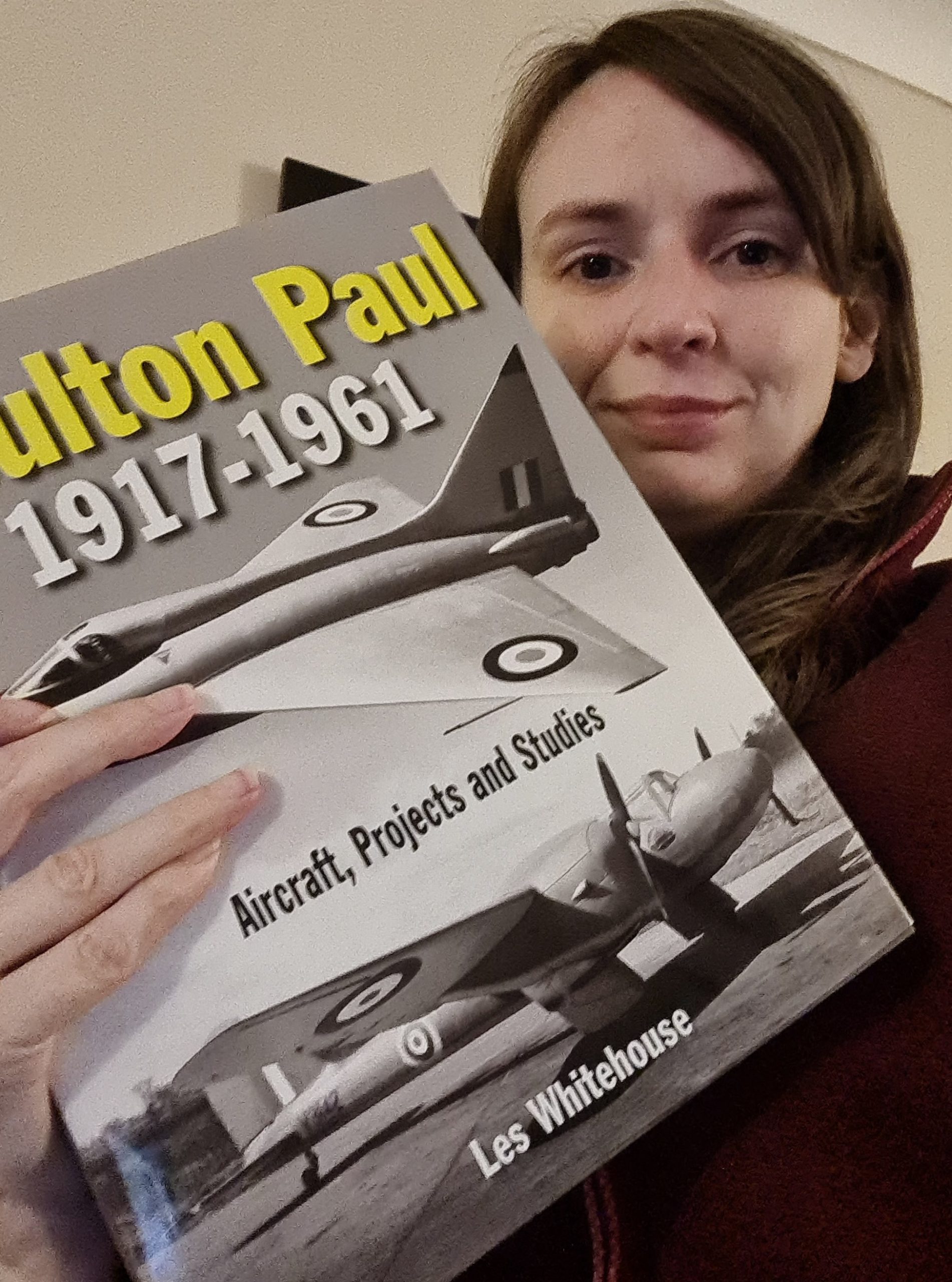
I should probably begin this review by acknowledging that I have a bias. The book is written by my father, who was a Boulton Paul Aircraft engineer and formal historical advisor at the company over 20 years. As one Boulton Paul Association ex-apprentice and long serving engineer stated a few years ago ‘what he does not know about the company is not worth knowing’.
The book itself covers more than 150 prototype and project designs which were generated by Boulton & Paul and BPA during the period where the companies focused on airframe design, including more minor designs, some of which were never numbered at all.
The final list expands upon the list of projects created and first published in the author’s historical thesis back in 1971, However, to try and cover everything that the two companies did while they existed would take many more volumes. While multiple books about Boulton Paul exist, they are generally less specific and gloss over many of the activities the companies undertook. Compared with those there are many revelations in this book which covers mainly the aspects of development and technical ideas for each design and its fate.
Firstly, the note (explained at the rear) that general publications usually are quoting rounded size approximations which are rarely accurately researched. It is explained that up to the P.25 and P.29 series the Boulton & Paul dimensions were based on the War Department stressing system joined lengths and not on a projected planform, baffling for anyone trying to draw up the aircraft without this knowledge and original dimensioned drawings and documents.
Then we have corrections to the early numbering, confirming that, rather than having an ‘indication the P.1 to P.5 were fighter aircraft’, the P.1 and P.2 never existed, the P.5 was a misinterpretation of the number 3 in preparing handwritten lists by government officials and therefore, also never existed as drawings. The P.7, rather than the three prototype designs known was, in fact, covered by six basic designs plus variations.
We find that the production aircraft planned for the end of the war was the War Department’s ‘Bourges III with Puma’ (Boulton & Paul Bourges IV). Days after the war a quantity order was confidently expected even by the War Department officers. Instead a prototype was never converted, and the SD Puma engines sat dusty in the prototype shop into 1919. The company remained one of the sixteen or so key aircraft companies post war, despite the Air Ministry assuming they would simply return to their agricultural tools and sheds.
The P.11 had a massive potential for future air safety but neither the company nor the engine manufacturer chosen could finance the cost to introduce connected gearboxes and propellers, instead it gained a government order for the P.12 ‘Postal’ and the P.15 all metal structure.
We read about John Dudley North working towards reducing engine drag with his anti-turbulence (AT) rings but being piped at the post on his patents by Townend, who did not fully understand the complete reason for their efficiency or how to develop the ideas and shapes. North could only corner the market by tying the patents together and marketing them as ‘Boulton Paul Townend Rings’, even though he only ever produced rings based upon his own AT concepts and tests.
North’s six American-engined double decker biplane, which never rose beyond a scribbled scrap of paper is presented. We read that problems with the P.64 stability had only just been solved and approved by Flt. Lt. Boothman when a less experienced pilot, tasked with a second opinion, crashed it in a stalled low-level turn. We also view North’s idea to get heavily loaded bombers airborne using a composite aircraft with his new pneumatic turret, only for Mayo to pre-date him with his own patents.
The volume is abundantly illustrated with CAD or improved original drawings of each project. Here, published for the first time ever, for example, the true concept and original shape of the P.82 Defiant, before changes to the wing planform, manipulation of the fuselage, and wing pitch-down characteristics produced a much more compact and efficient machine structure, but now one unfortunately in which the fuel tanks were inboard of the wing joint, meaning that forward firing weapons, even if agreed, could not be introduced without more redesign. The P.92 turret fighter as it was proposed with a four cannon and four machine gun conformal turret and as it was being built in prototype form – contrary to the fictitious escort application fed to the press mid-war. The design developments which were dismissed as ‘too advanced for service use’ in the P.98 to P100 series and the move into jet projects and paper studies as the post-war aircraft industry finally condensed into two main financial groups are all explained. Each section also covers accurate design parameters, but to round it off we have complete size and performance tables of all in the summary appendices.
Worth having for the drawings, and numerous original cutaways, but also for anyone interested in technical aircraft design.
Mrs Debi Roberts CEng MIMechE MIET SFHEA MWES
Course Director – Transport Engineering, Staffordshire University
Anyone interested in obtaining a copy the link is here
Obituary
27th September 2020
Jack William Holmes
2nd August 1927 – 27th September 2020
It is with great regret we announce the passing of Jack Holmes on the 27th September 2020 aged 93.

Jack was one of the mainstays of the Boulton Paul Association, and for most of its existence at the old Boulton Paul Aircraft site he was the Chief Engineer of the Association, responsible for the manufacture of the Defiant static replica now at the Battle of Britain Museum, Hawkinge and the Overstrand Nose and Turret replica at Flixton Museum. When the museum had to close he continued to impart his metalworking skills and engineering knowledge to schoolchildren in Wolverhampton.
Jack was a Norwich lad who moved with his family to the general area of Claregate and Bilbrook in 1936 where his father was a key engineering shops manager for Boulton Paul Aircraft, and had been for the previous Boulton & Paul Aircraft and Experimental Department of Norwich. He was taken on in the Print Room during 1941 until a place could be organised in the works drawing office. At the time the company were delivering Defiant Mk.I and II Night Fighters and TT Mk.I Target Tugs plus developing experimental turret designs. It was in 1943 that he met his wife to be, Florence. He was given an apprenticeship dated 2nd August 1943 which was formally sealed on 16th August 1944 and accepted by the Board on 24th August 1944.
As the war moved onwards, despite being indentured to Boulton Paul as an apprentice, Jack felt a need to serve in the services and joined the RAF in 1945, much to the annoyance of the company. He served with 691 sqn at RAF Chivenor in Devon, operating as a winchman on Miles Martinette target tugs. When he returned he had to re-enter the Training School at an apprentice salary to complete his time. V. J. Johnson did not apply any sanctions for breaking his indentures because he and Jack’s father had been old friends. The last part of his apprenticeship was in the flight shed and this turned his head away from the drawing office into a love of hands-on aircraft fitting. His apprenticeship was closed short on 3rd January 1946, covering 29 months rather than the contracted five years, including his period in the RAF, and noted his completing service in the machine shop and on fuselage, ribs and wing manufacture.
By 1947 he was in the experimental department making parts for the Jet Delta prototypes. He was later tasked to work on the Balliol prototypes and with on-site repairs to the tailwheel mounting of one of the experimental Balliol aircraft, which had taken a hard landing at RAE. By 1950’s he was in charge of the fitting team which had to introduce the first dog-tooth leading edge on to a set of Supermarine Swift Wings. He was also involved in building the first of the Canberra B.I.8, 20mm cannon gun packs and tasked with learning as much as possible of the Redux process, a new method of bonding metal panels together.
He applied to take over a new department within the company in 1953, a dedicated X-Ray facility for inspecting components and looking for internal defects. It was as an apprentice myself in around 1970 that I first met Jack when he had small groups into the department and explained the X-Ray method for the inspection of undercarriage legs and Concorde pipework assemblies for defects.
Jack left the company in 1984 when the decision was made to close the Department and move the X-Ray work to Dowty Cheltenham, leaving Jack and his staff redundant. A small job in a leather shop in Wolverhampton sustained his family until he retired aged 72. He joined the BP Association (then called the BP Society) in 1991, as it was formed, voting for an improvement of its rules and regulations as the BP Association and supporting that Association and its aims for the rest of his life.
His knowledge, friendship, and wit will be sorely missed.
Les Whitehouse – Association Archivist
Obituary
12th July 2016
It is with great regret that we have to report the tragic loss of member Vaughn Meers on the 12th July 2016 to a blood clot on the brain. Aged 65, one was constantly reminded of a whirling dervish with all the things he managed to fit into his non-stop life. Vaughn’s enthusiasm for all things wheeled, flying or military in arms, was matched only by his enormous circle of contacts and his copious collection of relics.

A penchant for organisation by any means, beg, borrow or cajole, he was a considerable assist to the Boulton Paul Heritage Centre during their many open days. Those same organisational skills he utilised in his own ‘Wings & Wheels’ events for charity, particularly in the support of the Tettenhall Heritage Centre – with whom he was heavily involved. Vaughn was solidly set in his opinions, which remained virtually unchangeable once decided, with a never give up attitude and, in his own words, “a hide like a rhinoceros”. This bounce back undefeated mind-set made him both friends and foes over the years but he was guaranteed to stand firm on his thoughts. Whichever camp, you may have been in, his presence will be sorely missed by all who knew him; his passing undeniably much too soon.
His funeral will be held at Streetly Crematorium on Friday 29th July 2016, at 10:30 am.
Les Whitehouse – Association Archivist
Blue Plaque Unveiled for John Dudley North CBE
W/C 27th July 2015
On the 25th July 2015, members of the Boulton Paul Association joined with the Bridgnorth Civic Society, the Bridgnorth Mayor and Mayoress and specially invited guests to attend the unveiling of a Blue Plaque on the former Bridgnorth home of aviation pioneer John Dudley North CBE, former Managing Director and Chief Engineer of Boulton Paul Aircraft Ltd.
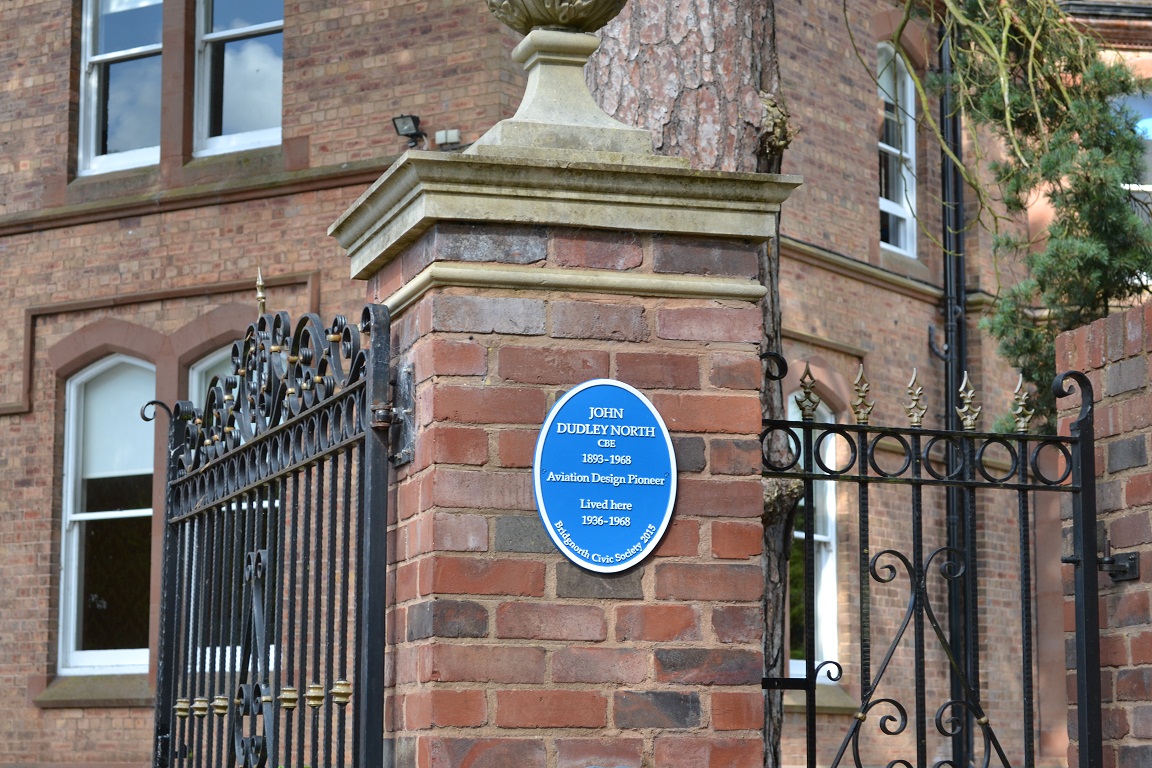
John Dudley North was born in January 1893 and educated at Bedford School, following the death of his father, he was unable to attend University and instead took up an apprenticeship within marine engineering. His obvious interest in aeronautics and man’s desire to fly led to him transferring to an aeronautical apprenticeship at Hendon under Horatio Barber, he then headed to the factory of Claude Graham White. He rose rapidly to become Chief Designer and Chief Engineer. Following time at Austin, he moved to Boulton & Paul at Norwich to set up the Aeronautical Department. He then formed a consortium to buy the division when it was sold in 1934.
In 1936 the renamed Boulton Paul Aircraft Ltd moved to Pendeford, Wolverhampton and North took up residence at Eversley House, Bridgnorth. He lived there until his death in January 1968, remaining a crucial and integral part of BPA and the aviation industry thoughout this time.

The Mayor spoke of North’s work as a lifetime advocate of improved air safety and his dedication to improvements in aircraft design before unveiling the plaque and then posed for photographs with the Boulton Paul Association members (Left to Right in the image above), Jack Holmes (Chief Engineer), Les Whitehouse (Archivist), Joyce Dunworth (widow of former BPA test pilot, Geoff Dunworth) and Cyril Plimmer (Chairman). An archive display of North’s life (collated by Association Archivist Les Whitehouse) was presented alongside light refreshments from the current owners of Eversley, Mr and Mrs John Murphy.
The Association would like to thank the Bridgnorth Civic Society, the Mayor of Bridgnorth; Cllr David Cooper and Mr and Mrs John Murphy for their efforts to get North’s contribution to aviation recognised and the unveiling and refreshments on the day.
Les Whitehouse – Association Archivist
Breaking News
Boulton Paul News Update by Archivist Les Whitehouse
W/C 19th January 2015
The Boulton Paul Defiant has been in the news more than normal in the last three years with the refurbishment of serial N1671 in 307 squadron guise as EW-D by the Medway Aircraft Preservation Society on behalf of the RAF Museum. Then more recently the problems of finding a home for the Boulton Paul Association’s own replica, currently stored by the RAF Museum on behalf of the Association. Classed as a full size model (FSM), this replica is wood clad with Alloy and fabric skinning.
Finished as L7005, 264 squadron PS-B, this replica represents the aircraft last flown by Flt Sgt E. R. “Ted” Thorne and Sgt F. J. “Fred” Barker on 26th August over Herne Bay. Following the combat with Dornier Do17Z bombers and their escorting Bf109 fighters, L7005 was crash landed and wrecked, while one of the bombers attacked by the squadron went on to ditch on the Goodwin Sands, subsequently being the subject of a the recent raising for preservation by the RAF Museum.
The Association is pleased to announce this week that it has completed the deal to preserve the replica L7005 by donating it to the Battle of Britain Museum at Hawkinge in Kent. It only remains to arrange a specific date for the replica to be moved from RAFM Cosford deep store to its new home.
Also this week saw the transport of other Boulton Paul Association’s artifacts into permanent preservation. The Boulton & Paul P.6 replica; Boulton & Paul P.75 Overstrand replica nose; Gnat ground trainer nose and the nose of a two seat Hunter (finished as the sole Hunter Mk 12, the “Green Hunter” used for extensive Boulton Paul Aircraft “fly-by-wire” flight control tests) have been transported to their new home at the Flixton Aviation Museum in Norfolk – a fitting location for the Boulton & Paul machines, the originals of which were manufactured in Norwich and assembled at Mousehold Heath Aerodrome, on its outskirts.
For modellers this was also a “red letter” week as Airfix made good on its announcement of the release of a new Defiant kit in 1/72nd scale at the International Plastic Modellers Society annual international event at the Telford Exhibition Centre last November. The new kit series is finally released to the public this week.
Anyone involved with building plastic kits will remember the original Airfix Defiant, bagged and sold when this writer was but a child, and available in “Woolworths”. The kit suffered from some serious shape inaccuracies based upon poor source drawings and the then Airfix perchant for raised rivets. As one employee put it to me years ago the standard design brief at the time was “-and we must have lots of rivets, the kids love rivets…..” With those sort of problems this model kit has long been ripe for improvement, including a complete nose re-graft, done by many of us over the years.

Nevertheless the model industry has moved on by leaps and bounds since those days and the new Defiant kit pays homage not only to the famous airframe but also to the latest techniques. The new kit used laser scanning techniques on the full size original, three dimensional CAD drawings and extensive research in addition to cross-referencing back to the original surviving drawings, photographs and maintenance manuals. The Association is proud to have been associated with the research involved in its creation via its archivist.
The top of the range is a “dogfight double” with glue and paints, covering the previously mentioned L7005, PS-B and Do17 5K+AR, the machine which has recently been raised and preserved by the RAF Museum. The basic Defiant kit on its own features PS-U L7013 of 264 squadron in the Battle of Britain (which survived the battle) and DZ-Z N3328 of 151 squadron (with sharkmouth), an aircraft frequently flown by ace Sgt Henry Bodien and his gunner Sgt D. E. O. Jonas . A third kit, defined as a starter kit (because it is supplied also with glue and paint) features N3333 YD-B 255 sqn when it was first being worked up in day fighter scheme.